Adaptability Quotient (AQ) at work: why adaptability is the ultimate survival skill for organisations
60,000 years of human evolution show one thing: those who best adapt to their environment survive, and thrive. Here is how that same principle translates to the workplace.
 By Kimberly Krul
Consultant & AQ Coach, Adapt
By Kimberly Krul
Consultant & AQ Coach, Adapt
"Adapt. Before you have to."
At Adapt, we often discuss adaptability and what it means. With adaptability, we focus on the evolution from reactive decision-making to full, organisation-wide agility and proactivity. We help organisations set and maintain a strategic course in a rapidly changing world.
One of the core qualities to achieve this is adaptability (also known as the Adaptability Quotient, or AQ). It means having a learning mindset and a good sense of when to change, and when not to. Sounds great, but in practice it presents many challenges, even though it should be second nature to us.
"Those who best adapt to the situation will survive. Not the strongest, but the most adaptable."
Kimberly Krul, Consultant & AQ Coach at Adapt
- 1Humans are built for adaptation. 60,000 years of history show that "survival of the fittest" really means: those who best adapt.
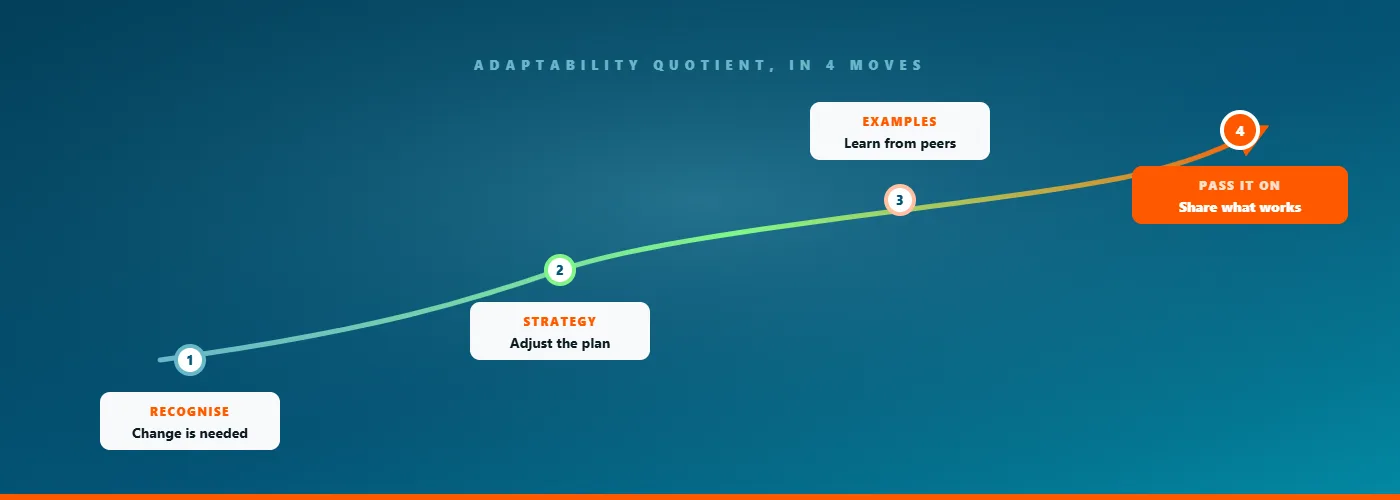
- 2Four moves make AQ practical: recognise change, adjust your strategy, learn from good examples, and pass on what you know.
- 3You can measure and grow AQ. An AQ assessment gives you (or your team) concrete insight into where you stand and where to develop.
Fit for survival
What do I mean by that? Humans are by nature one of the most adaptive beings on this earth, one of the reasons we have grown so large in numbers. Human history shows that we are fit for survival. In this article we draw a parallel between how our adaptability helped us succeed in the past and how it can still help you today.
Adapt or die: AQ is more than survival
Humans (Homo Sapiens, to be precise) are one of the most successful organisms when it comes to adaptability. Over the past 60,000 years we have spread across the entire planet. We can be found in the coldest, warmest, wettest and driest places on Earth, and we know how to survive there. Put an Amazon poison dart frog in the Sahara and it will not survive. Put a koala on the Veluwe with its almost exclusive eucalyptus diet, and it will not last long.
We, humans, thrive in many places because we know how to adapt well.
There are now 8 billion of us on Earth. That is a lot. How did we manage to grow so large? A large part of that increase is explained simply by the fact that we live longer. And why do we live longer? Because we have learned to adapt, and are capable of adapting or influencing our environment.
Adapt and innovate where possible
Over the past 200 years there have been significant innovations in food, disease and hygiene, allowing us to live longer. For example, we prevent serious infectious diseases by cooking our food properly and living more hygienically. Do you still get sick? Modern medicine prevents (vaccinations) and cures a great many diseases. In the past, people could die from a simple flu. So we have not only adapted our habits, we have also learned to look at our environment and innovate where possible.
These points, adjusting our habits and keeping an eye on our surroundings, are crucial in applying our adaptive capacity in working life. To clarify them, I refer back to the world-famous saying: survival of the fittest.
AQ has always been crucial for human innovation
The biggest misconception about "Survival of the Fittest" is, firstly, that it was said by Darwin, and secondly, that it implies the strongest have a greater chance of survival. In fact, Herbert Spencer coined the term after reading Darwin's On the Origin of Species. And the definition of Survival of the Fittest most closely resembles: those who can best adapt to the situation will survive. Darwin popularised the term by using it to explain the principle of evolution: natural selection. This ultimately ensures that organisms with the best genes for the situation in which they live will survive. Fit, therefore, translates to: adaptation.
Human adaptation
I mentioned earlier that our adaptability has helped us succeed in the past by adjusting our habits and innovating where possible. For a prime example, we need to go back quite a way in time: the Ice Age, about 20,000 years ago. The Earth's climate became much colder and drier; large parts of the planet were even buried under ice. To survive in these harsh conditions, humans changed their behaviour, technology and culture.
We learned to make warm clothes from animal hides and developed new tools for hunting and fishing. We observed how other animal species migrated along with the (relatively) warm weather, and decided to follow them. We also found ways to 'record' our lives and created spectacular cave art to pass on our knowledge to future generations. That is how humans managed to survive, whereas 'giants' like the mammoth, the woolly rhinoceros and the sabre-toothed tiger went extinct, because they struggled to adapt to the Ice Age.
I can hear you thinking: nice history lesson, but surely that is not relevant anymore these days? It certainly is. Let me explain why.
What we can learn from our ancestors
Thanks to our great adaptability during the Ice Age, we were able to:
- Recognise that change was neededExtreme cold made the old way of living untenable, so we noticed and named it.
- Adjust our strategyBetter hunting techniques, warmer clothing, new tools.
- Look for good examplesFollow the animals that migrated to warmer places.
- Pass on what we had learnedCave art as an early form of knowledge transfer to future generations.
If you look at the here and now, you can apply these same four points to the workplace. An ice age is not on the horizon anytime soon, but we all deal with change on a daily basis. Big issues like digitisation, climate change and the energy crisis, but also smaller ones like a new trend in your market or a new colleague or manager. How you handle these changes largely determines whether you can turn change into success. That applies to you as an individual and to your company. There are countless examples of people or companies that stubbornly clung to what they thought they knew, and ultimately fell behind.
Adaptability in the here and now
How do those four points translate concretely to the workplace? A few tips:
- 1. RECOGNISERealise that change is necessaryEnvironmental awareness keeps you close to developments, socially and in your field. It is equally important to accept that change is part of life, and an opportunity for growth.
- 2. STRATEGYAdjust your strategyKeep asking yourself (and your company): why do we do what we do, how do we achieve that goal, and what are we going to do exactly. Explicit choices make success less accidental.
- 3. EXAMPLESLearn from good examplesWhich peers have already solved a shared problem in your industry? Be inspired, watch trends, run scenarios. This prepares you for possible changes and helps you make the right choices.
- 4. TRANSFERPass it onChange only sticks when the organisation understands the new course and accepts the consequences. You do not need spectacular cave art, but storytelling makes your company's story clear and tangible, internally and externally.
Need proof that learning itself now works differently? Adapt founder Niels Huismans made exactly that case on the TEDx stage, years ago, but more relevant than ever. His plea to keep learning, unlearning and relearning is the engine behind a high Adaptability Quotient.
Ready to grow your AQ?
Hopefully, after reading this article, you have more confidence in human adaptability. Past results have shown that we are naturally very good at it. Change can be daunting, but it is always an opportunity for growth, for you and for your company.
Curious about your own adaptability or that of your team? At Adapt you can take an AQ assessment, individually or as a team. It gives you concrete insight into where your AQ sits today, and we help you grow it, both as an individual and as an organisation.
Want to know what AQ can do for you or your organisation?
Plan a 20-minute call with Kimberly. No sales pitch, just a concrete first read on where your team stands and what to work on.
Kimberly KrulConsultant & AQ Coach